

















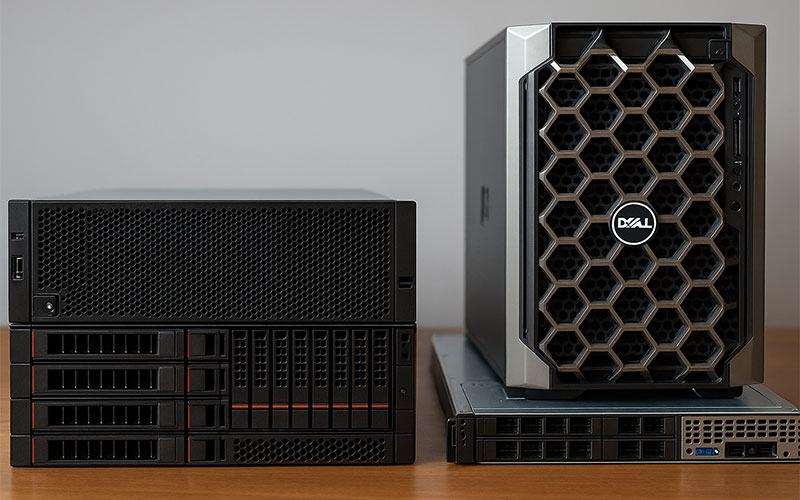
Lenovo and Dell lead the enterprise server market with robust, high-performance solutions. Lenovo emphasizes cost-efficiency and reliable uptime, while Dell excels in high-performance workloads and customization. Selecting the right server depends on business requirements, workload intensity, scalability needs, and total cost of ownership. WECENT helps enterprises navigate these choices, providing authentic hardware, OEM options, and expert deployment support.
What Are the Key Performance Differences Between Lenovo and Dell Servers?
Lenovo ThinkSystem and Dell PowerEdge servers deliver strong performance with Intel Xeon or AMD EPYC processors supporting up to 40 cores per CPU. Dell excels in AI, virtualization, and high-performance computing with advanced NVMe storage and enhanced configurations. Lenovo focuses on cost-effective reliability and energy efficiency. Both brands support cloud, analytics, and virtualization workloads effectively, making them suitable for diverse enterprise environments.
Think of servers as the “engines” that run a company’s digital operations, handling everything from storing data to running applications. Dell and Lenovo both make powerful servers, but they have slightly different strengths. Dell’s servers are especially strong when it comes to advanced tasks like artificial intelligence, virtual machines, or high-speed computing because they can use very fast storage and flexible setups. Lenovo focuses more on giving reliable performance while keeping energy use and costs lower, which is helpful for businesses that want dependable machines without spending too much on extra features.
Both brands can handle tasks like cloud computing, data analysis, and running multiple applications at once, making them suitable for many business needs. A company like WECENT can help businesses choose and set up the right servers from either brand, ensuring they get the best mix of performance, reliability, and efficiency. Essentially, the choice comes down to whether you need maximum speed and flexibility or cost-effective stability for everyday operations.
How Do Lenovo and Dell Compare in Terms of Customization and Scalability?
Dell servers offer extensive scalability with flexible PCIe Gen4 slots, NVMe/SSD/SAS storage options, and advanced networking capabilities. They are ideal for enterprises requiring tailored, growth-ready infrastructure. Lenovo servers provide competitive scalability with high RAM and storage capacity, emphasizing standardized configurations for faster deployment and simplified management. WECENT advises clients on balancing flexibility with ease of integration based on operational priorities.
When it comes to customization and scalability, both Dell and Lenovo offer strong options, but they approach it differently. Dell’s servers are highly flexible, offering a wide range of configuration options. For example, you can easily add more processing power, storage (like NVMe or SSDs), and upgrade networking components as your business grows. This makes Dell servers an excellent choice for companies that expect their infrastructure needs to change over time, as they can be tailored for complex environments.
On the other hand, Lenovo servers also offer good scalability, particularly in terms of RAM and storage, but they are designed with standardized configurations that make deployment faster and easier. While Lenovo servers may not offer quite the same level of customization as Dell, they excel in simplicity and reliability, making them suitable for businesses that need to get up and running quickly without as much complexity. At WECENT, we guide clients in choosing between these options, ensuring they strike the right balance between flexibility and ease of integration based on their specific needs.
Which Brand Provides Better Energy Efficiency and Cost-Effectiveness?
Lenovo servers are recognized for lower power consumption, translating to operational cost savings and efficient energy use, making them attractive for budget-conscious enterprises. Dell balances performance with power efficiency, offering reliable operations in energy-sensitive environments. WECENT helps organizations evaluate total cost of ownership, aligning server choice with long-term efficiency and budget targets.
Where Do Lenovo and Dell Stand on Remote Management and Support Services?
Dell iDRAC provides comprehensive remote management tools for monitoring, firmware updates, and maintenance. Lenovo XClarity Controller simplifies integration and operational workflows while maintaining stability. WECENT assists clients in leveraging these platforms, ensuring smooth IT operations, proactive maintenance, and maximized uptime across data centers and enterprise environments.
What Are the Security Features Distinguishing Lenovo and Dell Servers?
Both brands implement advanced security including silicon-level root of trust, secure boot, and firmware protection. Dell emphasizes system lockdown and cryptographic verification, while Lenovo focuses on embedded hardware security and firmware resiliency. WECENT ensures clients receive authentic, compliant hardware with manufacturer warranties and trusted security protocols for enterprise-grade protection.
How Does Working with IT Equipment Suppliers Like WECENT Enhance Your Server Deployment?
WECENT provides access to authentic Dell and Lenovo servers, OEM customization, and expert consulting. Their support spans product selection, installation, maintenance, and ongoing technical assistance. By partnering with WECENT, enterprises minimize deployment risks, optimize performance, and implement scalable, secure IT infrastructures tailored to their specific industry needs.
When Should Enterprises Choose Lenovo Over Dell for Their Server Needs?
Enterprises seeking lower total cost of ownership with dependable performance benefit from Lenovo servers. Their cost-efficient hardware, energy-saving design, and reliable uptime are suitable for small to mid-sized firms and large-scale deployments focused on operational efficiency. WECENT guides clients in evaluating workload requirements to select the most appropriate server configurations.
Can Dell Servers Deliver Superior Performance for High-Demand Workloads?
Dell PowerEdge servers, with advanced memory, storage, and processor options, excel in AI, big data analytics, and virtualization-heavy environments. Their customizable configurations and remote management capabilities support high availability and scalability requirements. WECENT assists clients in deploying Dell servers to achieve peak performance while maintaining system reliability and security.
Who Trusts WECENT for Enterprise Server Solutions and Why?
WECENT is relied upon by finance, healthcare, education, and data center clients worldwide. Their authorized access to Dell and Lenovo servers, combined with OEM customization, consulting, and full lifecycle support, enables enterprises to deploy secure, high-performance IT infrastructures with confidence. WECENT’s expertise ensures smooth integration and maximized operational efficiency across industries.
Server Feature Comparison Table: Lenovo ThinkSystem SR650 vs. Dell PowerEdge R750
| Feature | Lenovo ThinkSystem SR650 | Dell PowerEdge R750 |
|---|---|---|
| Processor Support | Intel Xeon Scalable (up to 3rd Gen) | Intel Xeon Scalable (up to 3rd Gen) |
| Maximum CPU Cores | Up to 40 cores per processor | Up to 40 cores per processor |
| Memory Capacity | Up to 4TB DDR4 | Up to 4TB DDR4 or DDR5 |
| Storage Options | Up to 24 NVMe/SSD/SAS | Up to 24 NVMe/SSD/SAS + Hybrid options |
| Power Efficiency | Efficient, lower power consumption | Balanced performance and efficiency |
| Remote Management System | Lenovo XClarity Controller | Dell iDRAC |
| Target Use Cases | Cost-effective enterprise IT | High-performance, customizable workloads |
WECENT Expert Views
“Choosing between Lenovo and Dell servers requires careful evaluation of workloads, budget, and management needs. Lenovo provides reliable, energy-efficient solutions at competitive prices, while Dell excels in high-performance scenarios with advanced customization and remote management. WECENT supports clients in selecting and deploying servers, offering OEM services and ensuring authentic hardware with full warranty support for optimal enterprise IT performance.”
How Can Companies Benefit from OEM and Customization Services Offered by Suppliers Like WECENT?
OEM and customization services allow precise configuration for enterprise needs, including branded designs, performance optimization, and seamless integration with existing infrastructures. WECENT provides tailored services, enabling wholesalers, integrators, and brand owners to differentiate their offerings and enhance operational efficiency.
Also check:
Compare performance benchmarks for Lenovo ThinkSystem vs Dell PowerEdge servers
Which servers are best for AI and GPU acceleration
Total cost of ownership Lenovo versus Dell for 3 years
Which vendor has better enterprise support and warranties
Energy efficiency and cooling comparison between the two brands
Conclusion
Choosing between Lenovo and Dell servers depends on balancing performance, cost, scalability, and management needs. Lenovo excels in cost-efficiency and energy savings, while Dell leads in high-demand workloads and customization. Partnering with WECENT ensures access to authentic hardware, OEM services, and expert deployment support, enabling enterprises to build secure, high-performance IT infrastructures aligned with strategic goals.
FAQs
1) Which server brands are best supported by WECENT for Lenovo vs Dell comparisons?
WECENT provides original servers and support for major brands including Dell and Lenovo, ensuring authentic hardware, manufacturer warranties, and tailored enterprise solutions for data centers and virtualization.
2) How should I evaluate Lenovo vs Dell for data center server workloads?
Focus on performance per watt, expansion options, total cost of ownership, reliability, and firmware/management tooling. Dell often scores well in lifecycle services; Lenovo emphasizes density and energy efficiency for scale-out deployments.
3) What deployment considerations matter most when choosing between Lenovo and Dell servers?
Assess rack density, memory capacity, PCIe expansion, cooling requirements, and integration with existing IT stacks. WECENT helps with configuration, installation, and ongoing technical support to optimize deployment.
4) Are Dell servers more cost-effective than Lenovo in enterprise environments?
Cost effectiveness depends on configuration, warranty terms, and service levels. Dell may offer competitive financing and broader global support, while Lenovo can excel on efficiency and density in large-scale racks.
5) Which brand offers stronger management and virtualization tooling?
Dell PowerEdge systems pair with strong management suites and VMware integration, while Lenovo ThinkSystem emphasizes unified management for scalable virtualization environments.
6) How do I approach procurement and OEM options with WECENT?
Engage with WECENT for OEM and customization options, ensuring branded, high-performance servers with manufacturer-backed warranties and tailored provisioning for your business needs.
7) What about support and service after purchase?
WECENT provides installation, maintenance, and technical support across Dell and Lenovo lines, backed by manufacturer warranties and responsive service teams.
8) Which should you choose for AI and big data workloads?
Both brands offer robust server platforms; prioritize GPU readiness, PCIe lanes, memory bandwidth, and cooling. WECENT can tailor configurations to optimize AI pipelines and big data analytics.