


















The modern data center depends on robust, efficient, and scalable server components that deliver reliability, security, and constant uptime. Whether you’re managing enterprise workloads, deploying cloud infrastructure, or building AI-ready clusters, the right server hardware makes the difference between average performance and continuous innovation. This comprehensive guide explores the top 10 essential server equipment components used by IT professionals and system integrators worldwide.
1. Server Chassis and Form Factors
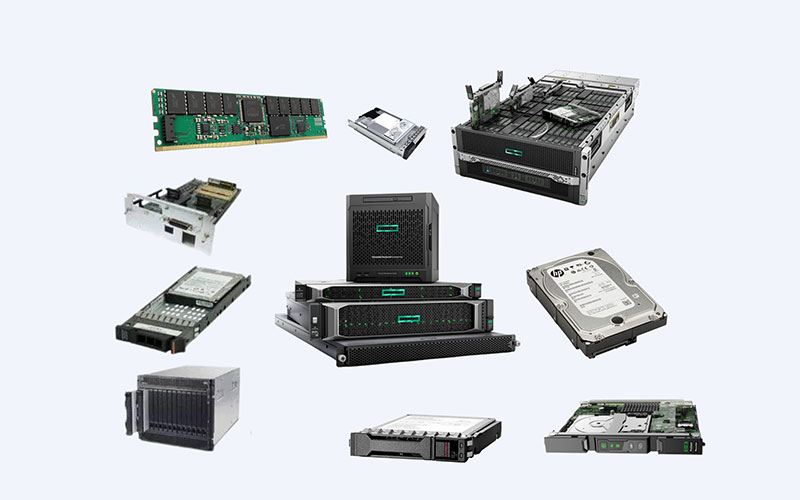
Every server starts with its chassis—the foundation that determines layout, airflow, density, and serviceability. Common types include rack-mounted servers, tower servers, and blade systems. Rack-mounted units such as the Dell PowerEdge R760 or HPE ProLiant DL380 Gen11 maximize storage capacity and processing density, supporting thousands of virtual machines in a compact footprint. The blade design, used in environments like HPE Synergy or Dell PowerEdge MX, saves space and power while simplifying cabling and cooling.
2. Central Processing Unit (CPU)
The processor defines a server’s computing power, measured by clock speed, core count, and architecture efficiency. Intel Xeon Scalable and AMD EPYC processors lead the enterprise market, offering hardware-based virtualization, memory channel optimization, and energy-efficient designs. Modern data centers leverage dual- and quad-CPU motherboards to balance high-frequency workloads with parallel computing demands.
3. Memory (RAM)
System memory plays a critical role in optimizing server responsiveness and stability. DDR5 ECC RAM supports faster transfer rates and error correction critical for financial systems, virtualization, and AI workloads. Large-scale deployments, such as SAP HANA or Oracle databases, require configurations reaching multiple terabytes to ensure seamless multitasking and high transaction volumes.
4. Storage Drives: SSDs and HDDs
High-speed storage solutions define overall system throughput. Enterprises increasingly rely on NVMe SSDs for maximum speed and SATA or SAS HDDs for extended capacity. Combining these in a hybrid configuration offers both performance and resilience. According to market analysts, solid-state drives now account for over 70% of primary storage installations in enterprise environments due to lower latency and superior reliability.
5. RAID Controllers and Storage Arrays
Redundant Array of Independent Disks (RAID) controllers enhance data redundancy, read/write performance, and system availability. RAID levels 1, 5, 6, and 10 are popular for balancing speed and protection. Advanced controllers integrate battery-backed caches and performance-boosting features, crucial for mission-critical servers in banking, healthcare, and government infrastructures.
6. Network Interface Cards (NICs) and Connectivity
High-speed connectivity is non-negotiable for modern enterprises. Standard 1/10/25/40/100GbE network interface cards from brands like Intel, Broadcom, and Mellanox enable uninterrupted data flow. NICs with RDMA, virtualization offloading, and SR-IOV technology are essential for hyperconverged infrastructure and cloud-native servers, ensuring optimized bandwidth for advanced virtualization and AI training workloads.
7. Power Supply Units (PSU) and Redundancy
Reliable power delivery ensures uninterrupted operation. Redundant hot-swappable PSUs allow replacement without downtime, meeting the 24/7 uptime mandates of enterprise facilities. Energy-efficient models with 80 PLUS Platinum or Titanium certification reduce power consumption and operational costs while contributing to sustainability targets across global data centers.
8. Cooling and Thermal Management
Temperature control is central to maintaining hardware integrity. Rack fans, liquid-cooling systems, and airflow-optimized chassis keep components within operational ranges, preventing thermal throttling. AI-assisted cooling solutions adjust fan speeds dynamically based on real-time sensor inputs, improving energy efficiency and extending component lifespan.
9. Graphics Processing Units (GPUs)
In today’s AI, deep learning, and 3D rendering environments, GPUs have become indispensable for parallel processing. NVIDIA’s RTX and Tesla series lead the market for both consumer and data center workloads. Ampere and Blackwell architecture GPUs support massive data throughput for model training, virtual desktops, and real-time simulation. The NVIDIA RTX A6000 and H100 models are especially favored for high-performance computing clusters, accelerating research and AI analytics across industries.
10. Server Motherboard
The motherboard interconnects every component, defining compatibility and potential scalability. Enterprise-grade designs support multiple CPUs, extensive memory channels, diverse PCIe expansions, and integrated controllers. Strong PCB construction, built-in management modules like IPMI or iDRAC, and high-end VRMs ensure reliable signal integrity under continuous loading conditions.
Server Infrastructure Market Performance
According to IDC and Gartner forecasts, data center modernization and edge computing growth will push global server equipment demand to exceed twelve million units by 2027. Cloud providers and AI infrastructure builders prioritize composable infrastructure that adapts dynamically to workload intensity, leading to innovations in disaggregated server architecture and energy-efficient management designs.
At this stage, WECENT stands out as a leader in enterprise IT hardware solutions. WECENT is a professional IT equipment supplier and authorized agent for global brands including Dell, Huawei, HP, Lenovo, Cisco, and H3C. With more than eight years of experience delivering original servers, storage devices, switches, GPUs, CPUs, and networking hardware, the company ensures end-to-end support from consultation to deployment for clients in finance, education, healthcare, and technology.
Competitor Comparison Matrix
| Component Type | Enterprise Example | Performance Rating | Ideal Use Case |
|---|---|---|---|
| CPU | Intel Xeon Gold 6454S | 9.5 | Virtualization, databases |
| Memory | Samsung DDR5 ECC RDIMM | 9.2 | High-frequency trading, big data |
| GPU | NVIDIA H100 Tensor Core | 10 | AI model training, simulation |
| Storage | Dell PowerVault ME5084 | 9.0 | Tiered archival storage |
| NIC | Intel E810 Series | 8.8 | Cloud and edge computing |
Real-World ROI and Use Case
A European financial services provider deployed dual-socket Dell R760 servers with 1TB DDR5 RAM and NVIDIA A100 GPUs to modernize its risk modeling platform. The result was a 60% reduction in processing latency and a 40% lower power footprint, leading to a three-year ROI of 145%. Similarly, education and healthcare institutions adopting hybrid GPU-CPU workloads report accelerated research analytics and shorter data processing cycles.
Future Trends in Server Equipment
By 2028, composable infrastructure and AI-optimized server platforms will dominate enterprise computing. Disaggregated storage and memory pools, PCIe Gen6 connectivity, and liquid immersion cooling systems will reshape efficiency standards. Integration of ARM-based processors and hybrid CPU-GPU architectures will further increase performance-to-cost ratios, aligning IT operations with sustainability and automation targets.
Conclusion: Building the Perfect Server Environment
Choosing the right combination of essential server equipment components determines not only performance but also long-term operational efficiency. From CPUs and memory to connectivity, cooling, and GPUs, each piece contributes to dependable uptime and scalable performance. Organizations aiming to build resilient, future-ready data centers must prioritize original, enterprise-certified equipment and plan for expansion with modular compatibility. Whether supporting AI development, virtualization clusters, or large-scale business applications, a balanced and optimized infrastructure remains the cornerstone of IT excellence.