

















To build petabyte-scale storage for big data, enterprises should: (1) select high-density LFF chassis servers like Dell PowerEdge R760xd2 with 24+ SAS drive bays; (2) cluster 10–20 nodes to achieve 1–5PB raw capacity; (3) integrate enterprise storage controllers and backup solutions; (4) source OEM-compliant hardware from authorized partners with warranty backing and deployment support for seamless scalability.
Check: Storage Server
What Is Petabyte-Scale Storage and Why Does Big Data Require It?
Petabyte-scale storage equals 1,000TB per petabyte, essential for managing massive data volumes in analytics, machine learning, and AI workloads. Traditional single-server solutions fail due to density limits and I/O bottlenecks, necessitating distributed clustered architectures for enterprise uptime, cost-per-TB efficiency, and scalability in finance, healthcare, and data centers.
Big data applications generate exponential data growth, overwhelming standard storage. Clustered LFF servers like Dell PowerEdge R760xd2 address this by enabling high-capacity SAS drive arrays across multiple nodes, ensuring redundancy and performance for virtualization, cloud computing, and AI. WECENT supplies these original Dell systems with full warranties for reliable deployments.
Which Server Chassis Design Best Supports Petabyte Storage Clusters?
LFF chassis with 24+ bays, such as Dell PowerEdge R760xd2 and R740xd2, excel for petabyte clusters due to superior capacity per node (up to 672TB with 24x 28TB SAS drives), fewer nodes required, and better power efficiency compared to SFF designs.
LFF designs prioritize storage density in 2U racks, supporting 24-28 SAS bays with redundant backplanes for RAID 6/10 configurations. Dell PowerEdge Gen16 models like R760xd2 integrate seamlessly in clusters, minimizing rack space and maintenance for data center operators.
| Criterion | LFF Chassis (24+ bays) | SFF Chassis (10–15 bays) |
|---|---|---|
| Capacity per node | 576TB–672TB (24× 24TB SAS) | 200TB–360TB (12× 30TB SAS) |
| Nodes needed for 1PB | 2–4 nodes | 5–8 nodes |
| Power efficiency | High (fewer nodes = lower overhead) | Lower (more nodes = higher overall power) |
| Maintenance complexity | Moderate | High (more drives to manage) |
| Cost per TB (TCO) | Lower | Higher |
How Do High-Capacity SAS Drives Enable Petabyte-Scale Architecture?
High-capacity SAS drives (12TB to 24TB) enable petabyte architecture through enterprise reliability, multi-channel I/O, and RAID compatibility, delivering sequential throughput for big data while outperforming SATA in dense, mission-critical clusters.
SAS drives offer MTBF exceeding 2.5 million hours, ideal for 24-bay LFF chassis like Dell PowerEdge R760xd2. Select based on workload—sequential for analytics, random for databases—ensuring thermal stability and firmware for RAID 6/10 in petabyte nodes. WECENT provides these original drives with manufacturer warranties.
What Storage Controller and Interconnect Architecture Powers Petabyte Clusters?
Dell PowerVault ME5 series controllers power petabyte clusters via modular expansion for PowerEdge nodes, paired with 10GbE/25GbE Ethernet interconnects; NVMe SSDs cache hot data, while RAID and replication ensure redundancy.
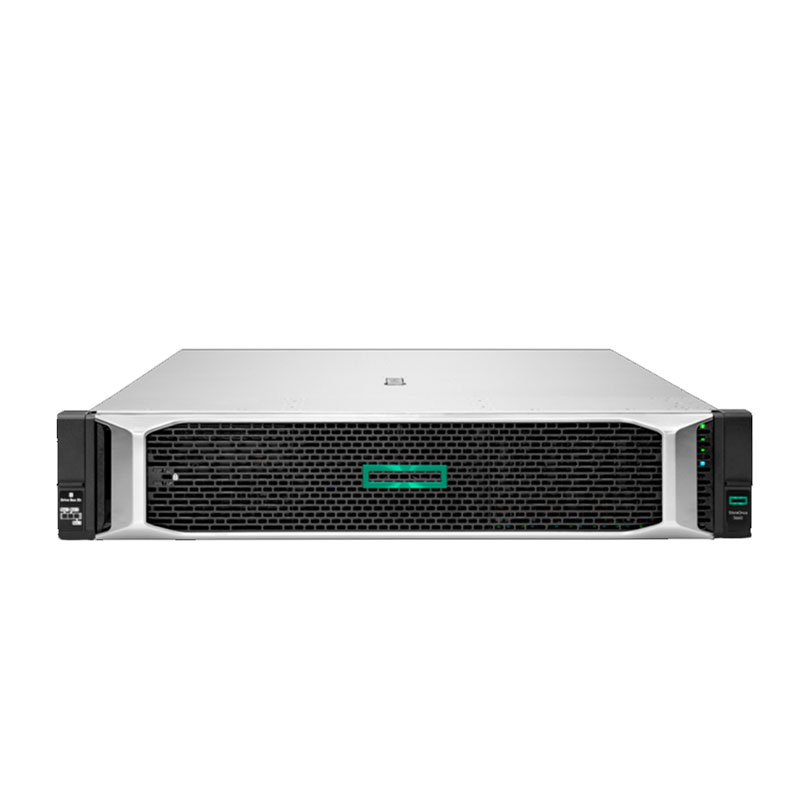
PowerVault ME5012/ME5024/ME5084 integrate with R760xd2 clusters for scalable SAN/NAS, supporting snapshots and tiered backups. Ethernet fabrics reduce latency in distributed big data environments, vital for data centers serving finance and healthcare.
WECENT Expert Views: “At WECENT, our 8+ years sourcing Dell PowerEdge clusters for big data clients has shown that coupling R760xd2 LFF nodes with enterprise SAS drives and PowerVault controllers—backed by OEM warranties—delivers 99.9% uptime and cost predictability that piecemeal sourcing cannot match.” – WECENT Enterprise Solutions Team
How Do You Calculate Capacity and Cost for Multi-Node Petabyte Deployments?
Calculate usable capacity as (drives per node) × (drive capacity) × (nodes) × (RAID efficiency, e.g., 0.667 for RAID-6); example: 20 nodes × 24 drives × 18TB × 0.667 ≈ 5.8PB. Factor in controllers, networking, power, and maintenance for TCO.
Check: WECENT Server Equipment Supplier
For a 1PB cluster, 4x R760xd2 nodes with 24x 24TB SAS yield ~576TB/node post-RAID. Hidden costs include 25GbE switches and cooling; WECENT’s OEM customization optimizes budgets for integrators via competitive wholesale pricing and bundling.
Which Enterprise Industries Benefit from Petabyte-Scale Storage Solutions?
Finance uses 10–50PB for transaction logs and compliance; healthcare 5–20PB for imaging/genomics; education/research 2–10PB for analytics; data centers 50–500PB for multi-tenant storage—all leveraging OEM hardware for GDPR/HIPAA/SOX compliance.
Dell PowerEdge R760xd2 clusters with PowerVault ME5 meet vertical needs: finance for real-time analytics, healthcare for secure archives. WECENT’s authorized Dell sourcing ensures warranty-backed, compliant deployments for global enterprises.
What Are the Key Implementation Challenges and How Can They Be Mitigated?
Mitigate scalability with pre-planned clustering; uptime via RAID/hot-spares/failover; supply risks by sourcing from authorized agents like WECENT; integration via end-to-end consulting and support.
Challenges include I/O bottlenecks (validate 25GbE), redundancy gaps (firmware updates), and procurement risks (non-original hardware). WECENT mitigates with original Dell PowerEdge, installation services, and global logistics for seamless petabyte builds.
How Does WECENT Support Petabyte-Scale Storage Deployments?
WECENT supports via authorized Dell/HPE/Lenovo agency, 8+ years expertise, OEM customization of R760xd2/PowerVault clusters, lifecycle services from consultation to maintenance, and original hardware guarantees at competitive pricing.
As China-based global supplier (szwecent.com), WECENT delivers pre-configured LFF clusters for big data, GPU integration for AI, and white-label options for wholesalers. Case: 12-node R760xd2 deployment yielded 2.8PB, 30% TCO savings, 99.95% uptime.
Conclusion
Building petabyte-scale storage for big data demands high-density LFF chassis like Dell PowerEdge R760xd2, enterprise SAS drives, and clustered PowerVault architectures for efficiency and reliability. Procurement risks and integration hurdles require trusted partners. WECENT’s 8+ years as authorized agent for Dell, HPE, Lenovo, Huawei, Cisco, H3C—offering OEM customization, original guarantees, and full lifecycle support—empowers IT procurement managers and data center operators worldwide.
Ready to build your petabyte-scale cluster? Contact WECENT’s enterprise solutions team for tailored configurations, pricing, and deployment roadmaps backed by proven big data expertise and manufacturer warranties.
Frequently Asked Questions
What is the minimum node count to justify petabyte-scale storage investment?
Generally, 2–3 nodes for RAID redundancy; 5–10 recommended for production. WECENT suggests 4-node pilots with Dell R760xd2 to validate before full petabyte scaling.
Can I mix different LFF chassis models in the same petabyte cluster?
Yes, R760xd2, R750xd2, R740xd2 interoperate via unified controllers. Standardize generations for simplicity; WECENT guides heterogeneous configurations.
What’s the power and cooling footprint for a 1PB cluster?
40–60kW for 10-node R760xd2 (15–20 RU), needing 200–300 amps @ 208V. WECENT assesses power/cooling in deployment planning.
Are SAS drives truly necessary, or can I use cheaper SATA drives for big data?
SAS provides superior MTBF, I/O, and RAID for critical clusters; SATA suits backups. WECENT recommends SAS primary, SATA tiered.
How does WECENT ensure hardware authenticity for petabyte clusters?
As authorized OEM agent, WECENT ships original Dell/HPE hardware with packaging, docs, warranties, authenticity certificates, and compliance verification.